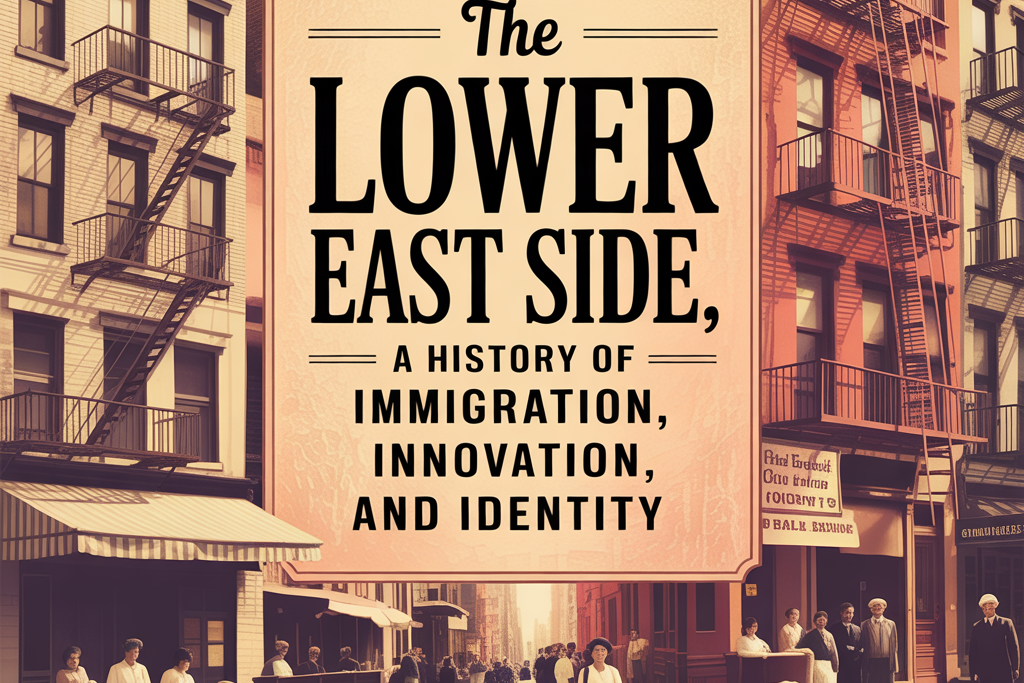
The Lower East Side: A History of Immigration, Innovation, and Identity
The Lower East Side of Manhattan stands as one of New York City’s most historically significant neighborhoods—a place where successive waves of immigrants built new lives, where labor movements took root, and where American urban culture was fundamentally shaped. This roughly two-square-mile area, bounded approximately by the East River, the Bowery, Canal Street, and East Houston Street, has witnessed dramatic transformations over more than three centuries.
Colonial Beginnings: Dutch and English Settlement
The area that would become the Lower East Side began as farmland during the Dutch colonial period in the early 17th century. Under New Amsterdam, the Dutch West India Company distributed land grants, or “bouweries,” to settlers who established farms extending from the southern tip of Manhattan northward. The word “Bowery” itself derives from the Dutch term for farm.
When the English took control of New Amsterdam in 1664, renaming it New York, the Lower East Side remained largely rural. A few country estates and working farms characterized the landscape through much of the 18th century. The area’s transformation from agricultural land to dense urban neighborhood would not begin in earnest until the early 19th century.
Early 19th Century: From Farmland to City Streets
The early 1800s brought significant changes. The Commissioners’ Plan of 1811, which established Manhattan’s famous grid system, laid the groundwork for urban development. As New York’s population grew rapidly—from roughly 60,000 in 1800 to over 200,000 by 1830—the city expanded northward from its colonial core at the island’s southern tip.
The Lower East Side’s location near the waterfront made it attractive for workers employed in the maritime trades, shipbuilding, and early manufacturing. Small wooden houses and modest brick row homes began replacing farms. By the 1830s and 1840s, the neighborhood had developed into a working-class district.
The First Great Wave: Irish and German Immigration (1840s-1880s)
The neighborhood’s character fundamentally changed with the massive immigration of the mid-19th century. Two groups arrived in particularly large numbers: the Irish, fleeing the devastating potato famine of 1845-1852, and Germans, many of whom left their homeland following the failed revolutions of 1848.
The Irish concentrated in areas like the notorious Five Points district (which overlapped with today’s Chinatown and the southern edge of the Lower East Side) and along the waterfront. They took jobs as laborers, dock workers, and domestic servants—occupations that reflected both the limited opportunities available to them and the discrimination they faced.
German immigrants, who numbered over 400,000 in New York by 1880, established what became known as “Kleindeutschland” or Little Germany, centered roughly between Avenue A and the East River, from Houston Street to 14th Street. This community created a robust cultural infrastructure: German-language newspapers, churches (both Catholic and Lutheran), beer gardens, mutual aid societies, and social clubs. Tompkins Square Park became a gathering place for German residents. By the 1870s, this was the largest German-speaking community outside of Berlin and Vienna.
The Tenement Era: Housing and Living Conditions
As the population density increased dramatically, a new form of housing emerged that would define the Lower East Side for generations: the tenement building. These multi-story residential structures, typically five or six floors high, were designed to maximize the number of families that could be housed on a single lot.
Early tenements, built in the 1830s through 1860s, often consisted of railroad-style apartments—narrow units arranged one behind another with minimal ventilation or natural light. Interior rooms had no windows at all. Families of five, six, or more might occupy a three-room apartment of 325 square feet. Outdoor privies in rear yards served multiple families, and clean water was not always readily available.
The Old Law Tenements, constructed after 1879, represented a modest improvement. Following legislation that required better ventilation, these buildings featured narrow air shafts between structures. However, these shafts often became repositories for garbage and provided little actual air circulation. The cramped quarters remained breeding grounds for disease—tuberculosis, cholera, and typhoid fever swept through the neighborhood periodically.
Jacob Riis, a police reporter and photographer, documented these conditions in his groundbreaking 1890 book How the Other Half Lives. His photographs and written accounts exposed middle and upper-class New Yorkers to the realities of tenement life, showing families living in dark, overcrowded rooms, children sleeping on fire escapes during hot summers, and the general squalor that characterized much of the housing stock.
The New Law of 1901 mandated improved standards for new construction, requiring bathrooms inside apartments, better ventilation, and improved fire safety measures. However, thousands of older tenements remained in use for decades.
Eastern European Jewish Immigration: The Great Migration (1880s-1920s)
The most dramatic demographic shift came with the arrival of Eastern European Jews fleeing pogroms, persecution, and economic hardship in Russia, Poland, Romania, and other parts of the Russian Empire and Austro-Hungarian Empire. Between 1880 and 1924, approximately two million Jews immigrated to the United States, and a substantial proportion settled initially on the Lower East Side.
By 1910, the Lower East Side was the most densely populated place in the world, with some blocks housing more than 500 people per acre. The Tenth Ward alone had a population density of 523.6 people per acre in 1894. The neighborhood became overwhelmingly Jewish—estimates suggest that by 1915, roughly 350,000 Jews lived in the Lower East Side, comprising about 70-80% of the area’s population.
This community established an extraordinary network of institutions and cultural life. Hundreds of synagogues—ranging from small storefront shuls to larger, more established congregations—served residents. The Educational Alliance, founded in 1889, offered English classes, vocational training, and cultural programs to help immigrants integrate into American life. Yiddish newspapers, including the Forverts (Jewish Daily Forward), became major publications with circulations in the hundreds of thousands.
The garment industry dominated economic life. Thousands of Jews worked in the needle trades as cutters, sewers, pressers, and finishers. Many labored in small workshops or “sweatshops”—cramped spaces where workers toiled for long hours under harsh conditions for minimal pay. Others worked at home, with entire families contributing to piece-work production.
Pushcart peddlers lined streets like Hester, Orchard, and Essex, selling everything from produce to housewares. The Hester Street market became legendary for its crowded, vibrant commercial activity. Orchard Street, in particular, developed into a major shopping district.
Italian Immigration and the Southern Lower East Side
While the northern and central portions of the Lower East Side became predominantly Jewish, Italian immigrants—primarily from southern Italy and Sicily—established communities in the southern sections of the neighborhood and in adjacent areas. The Italian population in New York grew from about 20,000 in 1880 to over 500,000 by 1910.
Italian immigrants often worked in construction, as street vendors, or in small trades. They established their own mutual aid societies, churches (most notably the Church of the Most Holy Crucible on Mulberry Street), and cultural organizations. The annual Feast of San Gennaro, which began in 1926, celebrated the patron saint of Naples and became a major neighborhood event.
Regional Italian identities remained strong—Sicilians, Neapolitans, Calabrians, and others often clustered together, maintaining distinct social networks and traditions even within the broader Italian community.
Labor Organizing and Social Movements
The concentration of garment workers and other laborers made the Lower East Side a center of labor organizing and radical political activity in the late 19th and early 20th centuries. Workers formed unions to fight for better wages, shorter hours, and improved working conditions.
The International Ladies’ Garment Workers’ Union (ILGWU), founded in 1900, organized women garment workers—who comprised the majority of the workforce in many shops. The Uprising of 20,000, a strike primarily of female shirtwaist makers that began in November 1909, demonstrated the power of organized labor. Young women, many of them Jewish and Italian immigrants, walked off their jobs demanding union recognition, better pay, and safer conditions. The strike lasted several months and drew national attention.
The Triangle Shirtwaist Factory fire of March 25, 1911, became a watershed moment. The factory, located in Greenwich Village but employing many Lower East Side residents, caught fire, trapping workers on the upper floors. One hundred forty-six workers, mostly young immigrant women, died—some from the fire and smoke, others after jumping from windows. The tragedy galvanized support for workplace safety regulations and labor protections.
The Lower East Side also incubated various political movements. Socialist, anarchist, and communist organizers found receptive audiences among workers struggling with poverty and exploitation. Speaker’s corners at Rutgers Square and other locations hosted passionate debates about economic justice, workers’ rights, and social transformation. Figures like Emma Goldman, an anarchist organizer, and labor leaders like Rose Schneiderman shaped both local and national political discourse.
Cultural Contributions and Community Life
Despite the hardships, the Lower East Side generated remarkable cultural vitality. Yiddish theater flourished, with numerous playhouses presenting dramas, comedies, and musicals that explored the immigrant experience, Old World traditions, and New World aspirations. The Yiddish Art Theater and other venues featured works by playwrights like Sholem Aleichem and Sholem Asch, as well as adaptations of Shakespeare and European classics.
Settlement houses, such as the Henry Street Settlement founded by Lillian Wald in 1893, provided crucial services. Wald and her fellow nurses offered healthcare, particularly to mothers and children. The settlement house movement also provided educational programs, recreational activities, and social services that helped immigrants navigate their new environment.
The neighborhood produced or nurtured numerous figures who would become prominent in American arts, entertainment, and public life. The Marx Brothers grew up on the Lower East Side. George Gershwin lived there as a child. Irving Berlin, born Israel Beilin in Russia, arrived as a young child and began his songwriting career while living in the neighborhood. Eddie Cantor, Al Jolson, and many other entertainers had Lower East Side roots.
Educational achievement became a pathway to advancement. Despite poverty, many immigrant families prioritized education for their children. Seward Park High School, opened in 1929, became one of the first educational high schools in New York and sent many graduates to college.
The Chinese Community Begins to Grow
While Chinese immigrants had established a small community in the Five Points area and what would become Chinatown in the mid-to-late 19th century, immigration restrictions—particularly the Chinese Exclusion Act of 1882—limited growth. The community remained relatively small and predominantly male through the early 20th century, centered around Mott, Pell, and Doyers Streets in what was then the eastern edge of the Lower East Side.
The population began to expand more significantly after World War II, when immigration restrictions eased, but this later development falls outside the scope of this early historical period.
Decline and Transition: 1920s-1950s
Several factors contributed to demographic changes beginning in the 1920s. The Immigration Act of 1924 imposed strict quotas that dramatically reduced immigration from Southern and Eastern Europe, cutting off the flow of new arrivals that had sustained the neighborhood’s population.
As families achieved economic stability, many chose to move to less crowded neighborhoods in Brooklyn, the Bronx, or Queens, where newer housing offered more space and better amenities. The opening of subway lines made these outer boroughs accessible. The Jewish population, which had peaked around 1910-1915, began a steady decline that would continue for decades.
The Great Depression of the 1930s hit the neighborhood hard, with unemployment reaching catastrophic levels. Federal programs provided some relief, but economic hardship was widespread.
By the 1940s and 1950s, the Lower East Side had become increasingly depopulated and physically deteriorated. Many tenement buildings fell into disrepair as landlords abandoned properties or provided minimal maintenance. The neighborhood that had once been characterized by overcrowding now faced abandonment and decay.
A Neighborhood That Shaped America
The Lower East Side’s historical significance extends far beyond its geographical boundaries. It served as the first home in America for millions of immigrants who would go on to contribute to every aspect of American life—business, arts, politics, labor, and culture. The neighborhood incubated labor movements that established protections still in place today. It generated cultural innovations that influenced American entertainment, literature, and cuisine.
The tenement buildings, the crowded streets, the markets, the sweatshops, and the synagogues represented both the hardships and the hopes of the immigrant experience. In navigating poverty, discrimination, and challenging living conditions, Lower East Side residents built mutual aid networks, cultural institutions, and community bonds that sustained them and provided pathways forward.
Understanding this history provides essential context for appreciating not only the Lower East Side itself but the broader American story—a narrative fundamentally shaped by immigration, urban transformation, and the ongoing negotiation between maintaining cultural heritage and adapting to new circumstances. The neighborhood’s past remains visible today in its architecture, institutions, and street patterns—tangible reminders of the millions of lives lived and the communities built in this small but historically vast corner of New York City.