East River Housing Corporation: A Legacy of Cooperative Living on Manhattan’s Lower East Side
In the dynamic landscape of New York City, where towering skyscrapers symbolize ambition and change, the East River Housing Corporation stands as a lasting example of community, affordability, and shared ownership. Located at 453 FDR Drive on Manhattan’s Lower East Side, this historic cooperative housing complex has represented stability and social progress for more than six decades. Built during a period of post-war optimism, it continues to embody the vision of urban renewal that sought to balance modern city living with community values.
The Origins of a Cooperative Vision
The story of East River Housing Corporation begins in the early 1950s—a time when New York City faced a severe housing shortage. Rapid population growth, coupled with economic inequality, created an urgent need for affordable homes. In response, a movement toward cooperative housing began to take shape, inspired by labor unions, progressive architects, and social reformers who believed that quality housing should not be a privilege reserved for the wealthy.
The project was conceived and developed by the United Housing Foundation (UHF), a non-profit organization established by labor leader Abraham E. Kaz. UHF’s mission was to provide decent, affordable housing for working-class families. Financial backing came from the International Ladies’ Garment Workers’ Union (ILGWU)—a powerful and socially active union that had already supported other landmark cooperative housing developments such as Amalgamated Housing in the Bronx and Hillman Housing nearby.
Construction of East River Housing began in 1953 and was completed by 1956. The complex was designed by George W. Springsteen and Harvey W. Corbett, who drew inspiration from the “towers in the park” design philosophy popularized by modernist planner Le Corbusier. This approach aimed to provide light, air, and open space to urban residents by surrounding high-rise buildings with landscaped grounds—a radical departure from the dense tenement blocks that had characterized much of the Lower East Side.
Architectural Character and Design
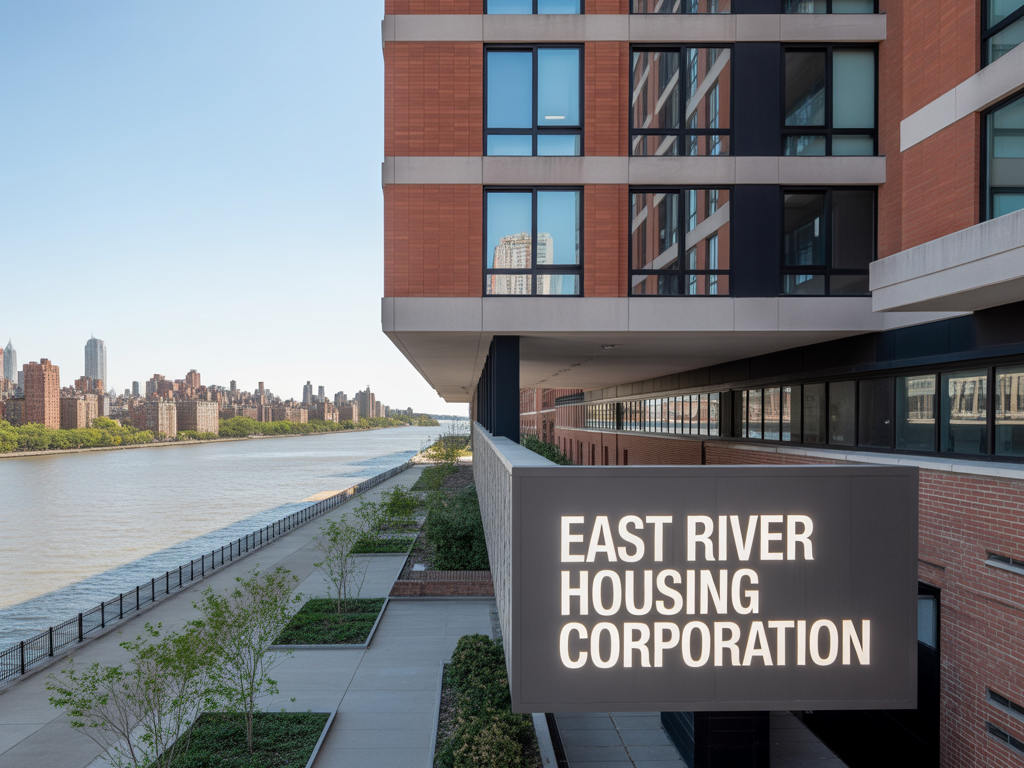
The East River Housing Corporation comprises four 20- and 21-story towers that rise along the East River between Grand Street and East Broadway. The layout provides sweeping views of the Manhattan and Williamsburg Bridges, as well as the East River itself. Each tower is set back from the street and surrounded by landscaped courtyards, playgrounds, and walking paths—features that were intended to foster a sense of community while offering relief from the surrounding urban environment.
The buildings were constructed with clean, functional lines typical of mid-century modern architecture. The apartments were designed for comfort and efficiency, with spacious living areas, large windows, and practical layouts that maximized light and airflow. Unlike many rental developments of the era, East River Housing emphasized owner-residents’ participation in maintaining and managing their own community.
The design also reflects the social ideals of the time: cooperative ownership, shared responsibility, and the belief that attractive, well-maintained housing could uplift entire neighborhoods. The development included on-site amenities such as laundry rooms, community spaces, and gardens, all intended to improve the residents’ quality of life.
The Cooperative Ideal
What sets East River Housing apart from most New York housing developments is its cooperative model. Instead of traditional landlord-tenant arrangements, residents purchase shares in the corporation that owns the property. Each shareholder has the right to occupy a specific apartment and to participate in decisions affecting the building’s operation and governance.
This system fosters a sense of collective ownership and empowerment. Residents elect a board of directors, set maintenance fees, and make policy decisions about repairs, improvements, and community rules. In essence, East River Housing is both a home and a democratic institution—a living example of how citizens can manage shared resources responsibly.
The cooperative model also keeps costs lower than in private developments, helping to preserve affordability in an increasingly expensive city. It provides long-term security to working- and middle-class families who might otherwise be priced out of Manhattan’s housing market.
A Community Rooted in Labor and Solidarity
The East River Housing Corporation was one of several developments that formed part of Co-op Village, a larger experiment in labor-sponsored housing on the Lower East Side. Together with Amalgamated Dwellings, Hillman Housing, and Seward Park Housing, it created a cluster of cooperative communities grounded in social ideals of mutual aid and equality.
These projects transformed what had once been one of New York’s most overcrowded and impoverished areas into a vibrant, middle-income neighborhood. They provided clean, modern apartments to thousands of families, many of whom were union members, immigrants, and first-generation Americans striving for stability and dignity.
The influence of the ILGWU is still visible in the cooperative’s ethos: an emphasis on solidarity, fairness, and collective action. Residents often describe East River Housing not merely as an apartment complex but as a community of shared purpose, where neighbors look out for one another and contribute to the upkeep and vitality of their surroundings.
Living by the River
Location is one of the East River Housing Corporation’s defining advantages. The complex sits directly along the FDR Drive, facing the East River promenade. From the upper floors, residents enjoy panoramic views of Brooklyn, the bridges, and the Manhattan skyline. The proximity to the river also provides a sense of openness rare in the dense urban fabric of New York.
Despite its waterfront position, the neighborhood maintains a distinctly local character. Nearby, residents can find essential amenities, cultural landmarks, and beloved eateries like Wa Lung Kitchen on Grand Street—just a short walk away. The Delancey–Essex Street subway station, several bus routes, and easy access to the Williamsburg Bridge make commuting convenient.
For recreation, East River Park, immediately adjacent to the complex, offers walking and cycling paths, sports fields, and scenic picnic areas. The presence of green space gives residents a sense of balance between city life and nature—a vision central to the cooperative’s original design philosophy.
Resilience and Renewal
Over the decades, the East River Housing Corporation has weathered the many transformations of New York City. The Lower East Side, once a working-class enclave of immigrants, has evolved through waves of gentrification, economic shifts, and cultural renewal. Through it all, the cooperative has remained a cornerstone of stability, maintaining its commitment to affordability even as surrounding property values soared.
In recent years, the community has faced new challenges, including the massive East Side Coastal Resiliency Project, an infrastructure initiative aimed at protecting Lower Manhattan from future flooding and sea-level rise. Portions of East River Park have been closed for redevelopment, temporarily affecting nearby residents. Yet the spirit of adaptation and collective problem-solving—long a hallmark of the cooperative—continues to guide East River Housing as it navigates these changes.
Governance and Resident Participation
The day-to-day operations of East River Housing are managed by an elected Board of Directors, which works closely with management staff to oversee maintenance, budgeting, and community affairs. Meetings are open to shareholders, who are encouraged to voice opinions and vote on key issues.
This participatory governance model ensures transparency and accountability. It also helps maintain the cooperative’s values across generations, as new residents join long-time members in shaping the future of their community.
Maintenance fees, known as carrying charges, are kept relatively modest, covering building upkeep, utilities, and shared amenities. Because East River Housing is not profit-driven, funds are reinvested directly into improving the property—a crucial distinction from private developments that prioritize return on investment.
Architecture Meets Community
Architecturally, the East River Housing Corporation exemplifies mid-century modernism adapted to social purpose. The “towers in the park” layout encourages interaction among residents while offering privacy and space. The open courtyards between the towers are more than landscaping—they are gathering places for neighbors, children, and community events.
Inside, the apartments are practical yet comfortable. Many units have balconies overlooking the river, and layouts emphasize natural light. Though some design elements may seem dated compared with newer luxury high-rises, residents often value the buildings’ solid construction and generous proportions—traits increasingly rare in contemporary developments.
Economic and Cultural Impact
From an economic standpoint, East River Housing Corporation represents a successful experiment in affordable urban homeownership. By combining cooperative ownership with government support and union initiative, it demonstrated a sustainable model for mixed-income living. Its success inspired similar projects throughout the city and helped establish cooperative housing as a viable alternative to speculative real estate.
Culturally, the development contributed to the transformation of the Lower East Side from a struggling neighborhood into a thriving residential community. It brought stability, improved infrastructure, and a strong sense of civic pride. Many families who moved in during the 1950s and 1960s still have descendants living there today, maintaining intergenerational ties that are increasingly rare in modern urban life.
Challenges in the Modern Era
In today’s housing market, East River Housing faces both opportunities and pressures. Rising property values in downtown Manhattan have increased the demand for co-op shares, sometimes leading to debates within the community about affordability, resale restrictions, and modernization.
Some residents advocate maintaining strict affordability rules to preserve the cooperative’s original mission, while others support selective reforms that would allow greater flexibility and attract investment for upgrades. The balance between preserving heritage and embracing change remains a central conversation.
Yet, even amid these discussions, the cooperative ethos remains intact. Decisions continue to be made democratically, and the sense of mutual respect among residents endures—a testament to the strength of the community’s foundation.
Legacy and Significance
The East River Housing Corporation’s legacy extends beyond bricks and mortar. It is a living monument to New York’s mid-century social vision—a belief that housing should be humane, affordable, and dignified. It exemplifies how public policy, organized labor, and architecture can come together to create environments that empower rather than exploit their inhabitants.
In an era when affordable housing has once again become one of New York City’s most pressing challenges, the cooperative serves as both an inspiration and a reminder. It shows that urban development need not be driven solely by profit; it can also be guided by purpose, cooperation, and compassion.
Visiting and Exploring the Area
For those interested in exploring the history of cooperative housing, a visit to East River Housing and the broader Co-op Village area offers a fascinating glimpse into mid-century urban planning. The neighborhood retains much of its original layout, with landscaped courtyards and functional architecture that still feel forward-thinking.
Nearby attractions include the Tenement Museum, which chronicles immigrant life on the Lower East Side, and the Essex Market, a revitalized food hall that blends old-world charm with modern tastes. The combination of historical continuity and contemporary vibrancy makes the area a microcosm of New York itself—where every block tells a story of change and resilience.
Conclusion
The East River Housing Corporation is far more than an apartment complex—it is a living community, a product of idealism, and a landmark in the history of American cooperative housing. Born from the union of social reform and architectural innovation, it continues to offer a model for equitable urban living.
From its origins in the post-war era to its ongoing role in a rapidly evolving city, East River Housing embodies the enduring belief that cities thrive when their residents share in both the responsibilities and the rewards of community life. With its riverside setting, democratic governance, and legacy of affordability, it stands as a beacon of what’s possible when collective vision meets civic commitment.